
Itosu Anko is the man from whom the most well-known karate styles trace back to.
He is the one that led karate out of the shadows of feudal culture into modernity, making it thrive as a means to forge minds and bodies of the young Japanese. He left such a mark that to this day he is celebrated as the forefather of Shorin-ryu, Shito-ryu, Shotokan and countless other styles.
But what if there was more? What if there was an entire lineage of Okinawan Bushi (martial artists) that never came in touch with Itosu’s innovations and their martial art was still alive today, hidden from the mainstream?
If you knew that such a style actually survived, I guess you couldn’t help but look desperately for more information, maybe in hope of a seminar to be held nearby.
That’s precisely what I did when around 2020 I discovered the existence of KishimotoDi.
An imposing man wearing an hakama, stands on a beach facing his opponent. He closes in almost ignoring the incoming attack and sends his partner flying into the sand. This is one of the first memories I have of what years later I would have called “my style”.
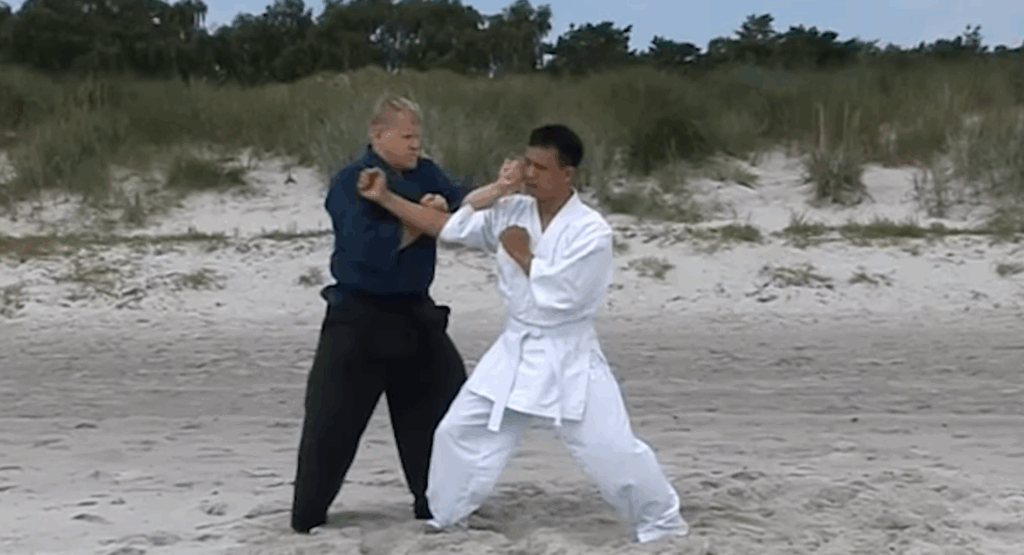
What the guy in the video was doing was close to incomprehensible to me at the time but, nonetheless, I felt fascinated by the grace and simplicity of his movements.
Given that Italy was under strict lockdown, I had all the time in the world to try to emulate the kata of KishimotoDi from the very few videos available online. Needless to say that to my disappointment no seminar was going to be organized in Italy or in nearby countries. In the end, it would take almost five years for me to properly start training in this ghost style.
But what is KishimotoDi? I will answer this question briefly and leave further explorations for another time.
Let’s start with what is not. KishimotoDi is not your average karate style with high kicks and point sparring.
From an historical point of view, it would be incorrect to classify KishimotoDi as karate to begin with. It is rather Toudi (China hand), specifically of the Shuri-te variation (Shuri was the royal capital of the Ryukyu Kingdom).
In fact, the name karate was only adopted officially in 1936 and the codification of the style very much predates that time and the reforms that were being made by most pioneers.
For example, one of the things that makes this art stand out so much from the modern conventions is that there is no belt grading system whatsoever. Proficiency is simply recognized by the number of kata that one has mastered.
Kata are the center of the system, and that is no big news for those who are familiar with Okinawan karate. The difference with KishimotoDi is that all the curriculum is comprised of just 4 forms: Naihanchi, Passai, Kushanku and Nidanbu.
With so “little” material to work with, one has to go deep rather than wide. That’s why in KishimotoDi applications are introduced almost immediately after an initial overview of Naihanchi, that provides the student with correct structure and footwork.
The versions of Naihanchi, Passai and Kushanku that are handed down in the style are totally different from almost all the known variations, and that’s due KishimotoDi unique lineage and history.
Like all of Shuri-te traditions, the oldest ancestor is Tode Sakugawa (1786 – 1867), whose most widely known pupil was Matsumura Sokon (1809 -1899). KishimotoDi instead stems from “Bushi” Tachimura (1826 – 1907), also a student of Sakugawa. Tachimura taught his art to Kishimoto Soko (1866 – 1945), who in turn had two known pupils of his own: Seiken Shukumine (founder of Gensei-ryu and Taido, 1925 – 2001) and Higa Seitoku (founder of the Bugeikan dojo, 1921 – 2006).
In the end KishimotoDi comes from the Higa side of the Kishimoto Soko lineage. This tradition only got its official name a decade ago, thanks to the pressure of foreign students that rightfully feared it was going to die out. As of now KishimotoDi has around 300 practitioners around the world making it one of the smallest karate styles in existence.
In the next part of the article I will go into further detail about KishimotoDi training and the overall transformation that my karate has undergone in the last year.
Leave a Reply